
Testimonials
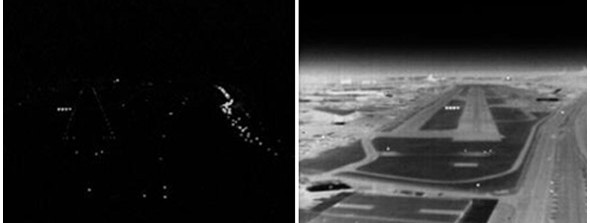
Max-Viz is the leader in Enhanced Vision Systems (EVS) for a wide range of applications. For 10 years, we have deployed EVS to many satisfied customers.
Hartleyarms this site
“Perspective EVS adds another dimension of safety to night operations. This complements and builds on Garmin’s Synthetic Vision Technology - which shows what SHOULD be there… now Perspective EVS shows you what is REALLY there.”
Former Cirrus Chairman and CEO Alan Klapmeier
“I could have used your Max-Viz system a couple of days ago. We departed for the rigs with 500 OVC and ½ mile in mist and fog, but the rigs were reporting clear. About 10 minutes later the airfield closed with 300 - 500 foot lateral visibility and 100 foot VV. Approaching the rigs we went lower and lower until at about 200 feet all we could see was the water. We approached the rigs on radar and began to see them at ¾ to ½ mile, but the fog/mist was blowing in waves so it was ‘now you see it, now you don’t.’ Needless to say we sat on deck for about six hours until the field went VFR.”
Excerpt from a CHC AW-139 Pilot
“The Max-Viz EVS-600 system, mounted under the left wing, displayed an image of what it could see ahead that I couldn’t. In fact, when we landed we were able to see a deer crossing the runway that would have been virtually impossible to see in the dark without the EVS.”
Tom Benenson, Flying Magazine
“I made a missed approach into Teterboro, NJ and had to divert to Newark on a low overcast day. After landing in Newark at minimums, I turned off the runway and the heavy fog settled in making the visibility close to zero zero. Although the EVS enabled me to see the taxiway edges, I still could not see that far in front of the aircraft. As I continued to taxi, I referenced the EVS once again and noticed four bright white glows just as I was about to taxi into the tail of a 747.”
Douglas Spicer, Chief Pilot, Cair Management
“We are based in the mountains and fly all over the country on charter business, therefore safety is the main reason why we had the Max-Viz EVS installed in our Lear 60. You can see everything with this system – it is incredible and we use it every day. There is one small airport in particular that we frequent in Texas and there are always deer on the runway. Now, we’ll be able to see them on approach.”
Steve Garmin, Chief Pilot, Sun Valley Air
“Inbound to Salem, OR their weather went below minimums so I was diverted to Portland were the visibility was fluctuating between RVR 1600 and 2200 under a thick fog layer. Things were happening pretty fast as I set up for the new approach during vectors to the ILS. As I turned on final and entered the fog I turned on the Max-Viz and immediately had the runway in clear view even though the RVR was still at minimums. Because there was still a possibility of a go around if the visibility went down again, it was very comforting to be able to see the runway clearly through the fog and complete the approach with confidence. A few weeks later I was flying an aircraft without Max-Viz but could really have used it. Landing to the north at McCall, ID the south end of the runway was clear but the north half of the airport was literally zero zero in fog. I touched down with no problem but entered the fog on rollout and was in a complete whiteout which made taxiing to the ramp very tricky and unsafe. Max-Viz would have been a great help.”
Tom Halvorson, Director of Charter Operations (PC-12)
“Saturday night I flew a charter where I went into Trophy Lake Golf Course (went in at 8 PM w/daylight) and departed at 10:30PM with a new bride and groom. When it was time to depart it was drizzling, dark and very minimal ground or sky illumination and lots of tall trees. The site I chose to land at had a nice departure route down the 18th fairway, but the EVS was extremely beneficial to the safe departure. I was able to make a max. performance climb with the fairway straight ahead, the tall trees on either side and the small lake under the my initial climb. I had along with me the chief pilot for Silver State Helicopters (Tacoma branch) in the copilot’s seat and he was absolutely amazed how the EVS performed. They were going to use one of their helicopters, but chose to defer the mission to our Bell 206. He later said the combination of good instrumentation and turbine power, etc. made for a much more comfortable and safe departure. The EVS was awesome! I wish I had a video. Just before departure I checked wx with the FSS and Bremerton airport was 8000′ ceiling and BFI 7000′ ceiling with good visibilities, but we could not easily tell if the ceiling was high at Trophy Lake from the ground. About 700′ agl after takeoff the EVS indicated we would be entering possible IMC, so we stopped the climb and turned towards the Bremerton city lights, and about 1 minute later were able to climb to 2000′ without a problem. The EVS assisted us in staying out of IMC weather, because the clouds showed up so well on the display. It’s ability to keep us over the centerline of the fairway and lake for the takeoff was obviously a huge benfit as well.”
Brad Pattison, Bell 206 Charter Pilot
“The ability to see is the greatest need of all, and the head-down Max-Viz EVS Enhanced Vision System is the best safety feature invented for aircraft since Weather Radar.“
Ron Freswick, Director of Aviation, Global Express
“The EVS is great for ground taxi operations. I don’t know how we lived without it before. On a recent operation, we were positioned behind a big jet that we simply could not see in the dark, but on the EVS it lit up just like a Xmas tree!”
John Lyon, Chief Pilot, CL-601-3A
“The ability to see, even in darkness, will allow our emergency helicopter flight operation to enhance airborne safety for our patients, pilots and public even further. The EVS was the clear and only choice for our operation.”
Steve Straughen, Director EMS Operations, Bell 412
“I’m amazed every time I fly the Max-Viz EVS. It literally turns night into day. My night pucker factor is now nil.”
Bruce Bennett, President, Aurora Aviation, Cessna 421T
“It really is a stress reliever, especially in night operations.”
Cirrus Market and Product Strategy Analyst Matt Bergwall
“Please share with your offices and others interested in Max-Viz’s EVS systems that I find that it is a great simple, passive safety system for situational awareness in aviation. Especially in VFR helicopter operations at night.
We selected the Max-Viz EVS1500 due to the need to reduce or mitigate the risks for our flight operations. Statistically, our Corporate/VIP flight operations in the Great Lakes region four season’s weather carry the elevated risk of controlled flight into terrain from disorientation at night and inadvertent instrument meteorological conditions (IMC) in the day and especially night flight.
Approximately 80% of the hazards related to our flight operations, based on accident statistics - can be tied to these risks. I determined that using a Max-Viz EVS system was easy for my clients, required minimal training and re-current training, and is compact and unobtrusive in the cockpit. But, best of all - it is the best single solution to mitigate and minimize these hazards for our operations.
I have found in a short amount of time, my comfort level in reduced visibility and night flight is much greater. I fly with it all the time and make it part of my scan.
If someone wishes to speak with me in person, have them contact me.
Thank you and Fly Safe!”
Kevin W. Nelson, President, Nelson AeroDynamiX, Corp.
“It’s definitely a love affair with both the magic of flight and with my new Turbo Cirrus which is absolutely incredible. My Cirrus Perspective is equipped with the Enhanced Vision System (EVS) which is terrific! To be honest with you, when I acquired the new airplane with the EVS system I thought it was really ‘cool’ and a neat ‘toy’ to show off, but I questioned its real usefulness. That all changed just a few weeks ago while I was flying with a nervous passenger (my sister) over to San Antonio for a conference at night. There were towers of cloud build-ups scattered around us. We were experiencing a few bumps as we rushing through them so I flipped the MFD to the EVS screen to get a better look at what was ahead. Anyone who’s flown in that area of the country at night knows it’s absolutely pitch black and you can hardly see beyond the propeller. Instantly, night turned into day and I had a picture perfect view of what laid in our path. I asked ATC for very minor deviations around the build-ups which they quickly granted. A few degrees here, a few degrees there - we didn’t experience so much as an ounce of turbulence the rest of the flight - and it was all thanks to the EVS system. Obviously, the biggest benefit of an EVS system is to enhance safety, but in this case, making a nervous flyer comfortable so that they actually enjoyed the flight rather than fearing it was worth its weight in gold. Fast forward a few weeks - the EVS system is now a staple in my toolbox for any of my night flights - of which there have been quite a few lately. I simply can’t imagine flying at night without it. I love using the split screen moving map display in conjunction with the EVS window for a comprehensive view of what’s ahead even when conditions are less than ideal. The terrain awareness functionality is equally as impressive giving you a clear picture of the surrounding area and runway environment coming into a field at night. Great job on developing such a terrific product which adds yet another level of safety to the Cirrus. Lastly, in case you’re wondering, yes, it’s still very ‘cool’ too!”
Brad Pierce - President, Restaurant Equipment World™, Pierce Sales Co., Inc